
How We Send Small Hotels a Monday Price Mail
Every Monday a small hotel gets one mail: its price, the cheapest reseller and its neighbours, night by night. The real mail, and how it is built.


A small hotel can sell a room at one price on its own site while a reseller lists the same room, for the same night, lower. The owner rarely sees it, because the owner is running a hotel.
So we built a Monday mail for that owner. It lists seven nights, the hotel's own price, the cheapest reseller, how the hotels nearby price the same nights, and a few plain sentences on what stands out. On Monday 26 October it left at 07:36 for sixteen hotels in the pilot, and on Monday 2 November, at 07:47, for twenty-six. The screens and mail lines below come from one of the 26 October mails, with the names replaced and every price changed to a made-up one.
This post walks through that mail section by section, then shows how it is built: a handful of Trawl scrapers and one n8n workflow that runs every Monday. It is a real product on top of scrapers, and the workflow is the part you can copy.
One person, one Monday question
A project for "hotels" goes nowhere. A project for one person with one recurring question can ship in two weeks. Ours is the owner of an independent hotel who sets the prices alone: no revenue manager, no pricing tool plugged into the booking system. Prices get checked by hand, on a few sites, when there is time.
The question, in the owner's words: which sites sell my rooms below my own site this week, and what do the hotels around me charge?
We chose the delivery before the data. A dashboard needs someone to open it, learn it and come back. An owner who checks prices by hand when there is time will not add a tab to that routine, so the answer goes to the inbox, every Monday, with nothing to log into and nothing to install.
What the Monday mail shows
The prices are read early on Monday and the mail leaves around 07:30 French time. The subject line is the hotel name and the week, for example "Hotel name · vos prix du 26 octobre au 1er novembre". The mail is written in French for now: the mail lines quoted below are translated into English, and the French labels keep a gloss.
It covers the seven nights from Monday to Sunday and compares three things for each night:
- Your price, the lowest public rate for your room on your own hotel page.
- The cheapest reseller, the lowest rate for the same room and night on price-comparison pages.
- Your competitors, usually five hotels. You can suggest them, or they are picked among the hotels listed next to yours.
All prices are the ones any guest would see, for two people and one night. Nothing comes from the hotel's own systems.
The week board
The mail opens with a short note on what it does, then Votre semaine ("your week"): seven columns, Monday to Sunday. Each column shows the weather, a dot with the number of local events that evening, and two bars side by side: your price and the median price of your competitors. One line under the board defines the median in plain words: the middle price of your five competitors, half above and half below.
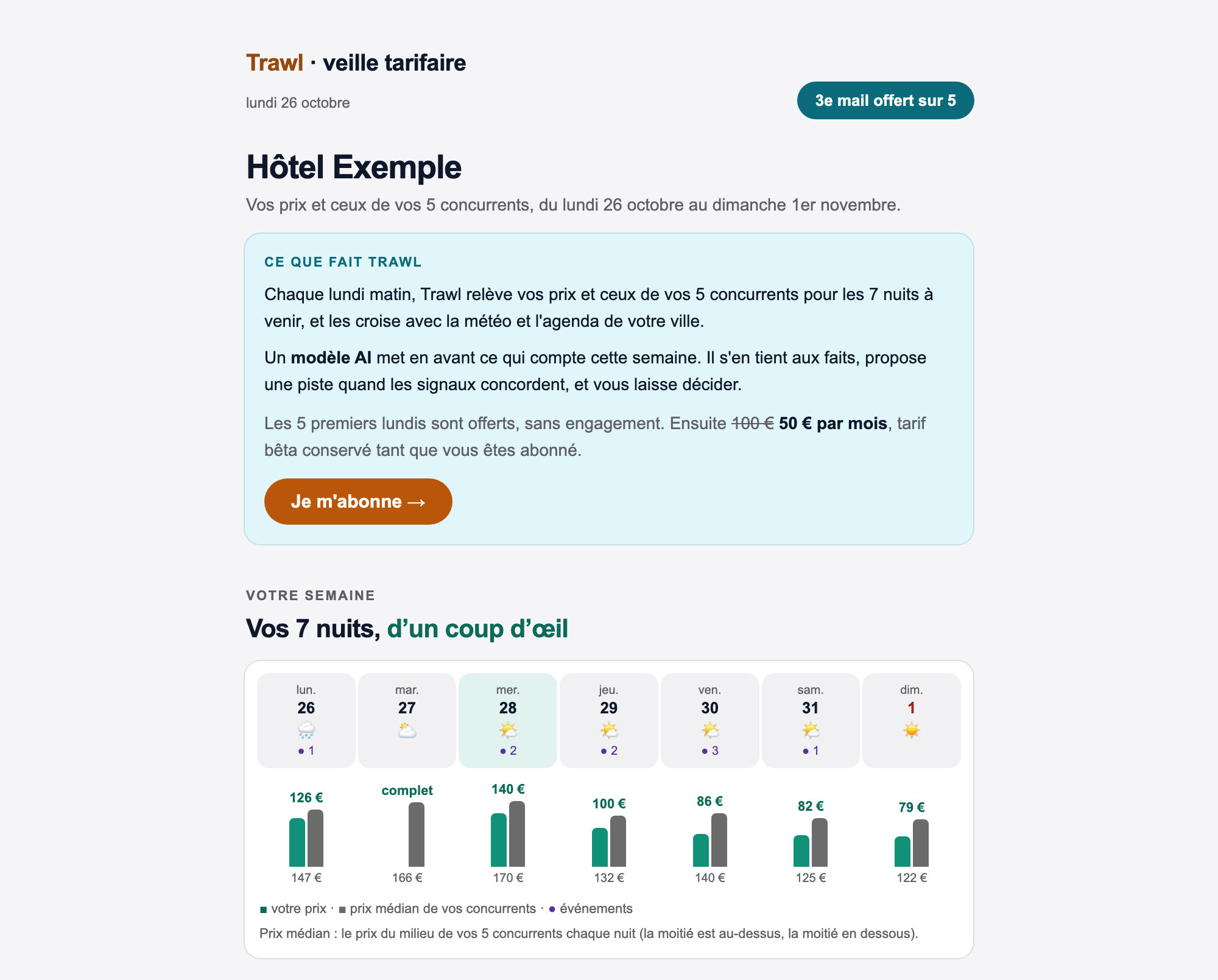
For a reader with thirty seconds, that board is the whole mail. Here the hotel sits under its competitors' median on every night it had a room to sell, and Tuesday shows complet (sold out) instead of a price. If one night jumps away from the others, read on.
The week in plain words
Under the board, À noter ("worth noting") says in two or three sentences what the week looks like. The note at the top of the mail says where those sentences come from: an AI model puts forward what matters this week, sticks to the facts, offers a lead when the signals agree, and leaves the decision to you. Every sentence is checked against the week's data before the mail goes out, so a number in the text is a number from the table.
Here is that block, from the same mail:
Worth noting
Your median price is 29 % under your competitors', and you
are the cheapest on 4 nights. Friday 30 October, an evening with events,
you are 54 € under your competitors' median price.

On 5 of the 6 nights compared, a reseller sells your room cheaper
than you.
In other words: your median price sits 29 percent under your competitors', and you are the cheapest of the six hotels on 4 nights. On Friday, an evening with local events, you are 54 euros under their median. And on 5 of the 6 nights that could be compared, a reseller sells your room for less than your own site does.
A second block, À ne pas oublier ("don't forget"), lists the dates ahead that can move prices. That Monday it held a bank holiday, three local fairs and the start of the Christmas school holidays.
Night by night
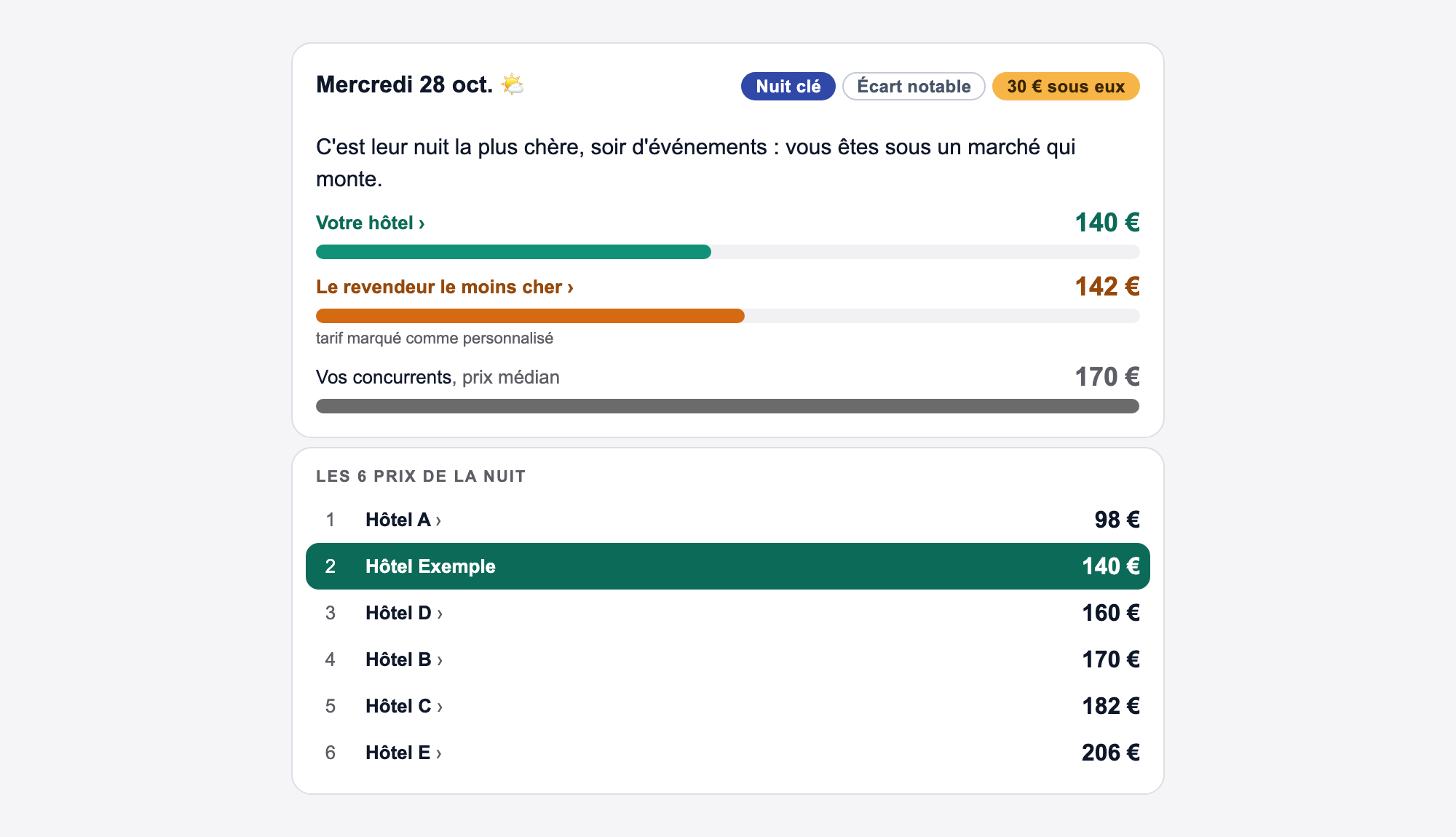
The longest part is Nuit par nuit ("night by night"): one card per night. Votre hôtel holds your price, Le revendeur le moins cher the cheapest reseller for that night, and Vos concurrents their median price. Under each card, Les 6 prix de la nuit ("the night's 6 prices") ranks your hotel among your competitors, cheapest first. When a hotel shows no price that night, the card gives a count such as "4 prix publiés · 1 sans prix" (4 prices published, 1 without a price). A reseller rate that the comparison page marks as personalised carries that mention under its price.
Some cards carry small labels. Nuit clé ("key night") marks the one night of the week that stands apart: your dearest night, your sharpest gap with your competitors, or the night their prices climb the most. Écart notable ("notable gap") marks a night where you moved away from your usual price much more, or much less, than the hotels around you moved from theirs. A third chip says in euros where you sit that night, for instance "30 € sous eux" ("30 € under them"). These labels inform, they do not grade you.
In this mail the key night was Wednesday 28 October. The hotel asked 140 euros, its dearest night of the week and 51 percent above its own median of 93, while its competitors sat only 12 percent above their usual level. It was also their dearest night, an evening with two local events, and the hotel still sat 30 euros under their median of 170. The card sums it up in one line: Their dearest night, an evening with events: you are under a rising market.
The plain-text version of the mail carries the same night lines. Three of them, from the same week, with the reseller names and one footnote mark removed, and the ranges rewritten with "to":
Mon 26 · You show 126 €: a reseller sells your room
9 € cheaper than you.
your hotel 126 € · reseller 117 € · competitors 110 to 173 €,
1 cheaper than you

Tue 27 · You are sold out on a night when your competitors sell
around 166 €, above your median price of 93 €.
your hotel: sold out · competitors 132 to 218 €

Thu 29 · Event night: a reseller sells your room 9 €
cheaper than you.
Lead: there is room to go up, if you have rooms left.
your hotel 100 € · reseller 91 € · competitors 120 to 196 €,
none cheaper than you
Read the first one as: on Monday your hotel shows 126 euros, a reseller sells the same room 9 euros cheaper, and your competitors range from 110 to 173, one of them below you. The second is a sold-out night, so there is no price of yours to compare and the line says what your competitors charge instead. The third adds a line starting with Lead, the closest the mail gets to advice, and it comes with a condition: room to go up, if you still have rooms.
What it leaves out on purpose
A price-watch mail is only worth reading if you can trust its silences.
- It never gives you a rate. It reports what is published. Every commercial decision stays with the owner.
- It says when a night cannot be compared. With fewer than three competitor prices read, a night is not measurable and the mail says so instead of guessing. A week with nothing to report says "Semaine sans relief" ("an uneventful week").
- It tells apart five situations that look alike in a table. A night can be complet (sold out), séjour min. (open only for a longer stay), pas de tarif en ligne (no online rate), pas d'offre directe (resellers sell your room but your own site shows no price), or not read at all (nuit non relevée). Each is written in words, never a blank cell.
- It counts only what it compared. "5 of the 6 nights compared" above leaves out the sold-out Tuesday: a reseller claim only counts nights where both prices were read.
After the nights come Les notes ("the ratings"): your hotel and your competitors ranked by guest rating, with arrows and review counts that compare with last Monday's mail. Then Votre analyse ("your analysis") says the mail is tuned by replying: change the competitor list, steer the analysis toward what matters to you, or ask a question. Replies go to Pierre, who reads them. The footer says who sends the mail, where the prices come from, and how to stop: reply STOP.
How it is built
There is no backend, no front end and no database of our own. The pieces are scrapers, a workflow and a spreadsheet.
Scrapers. The price data comes from public price-comparison pages, which already list a hotel's own site next to every reseller, room by room, and the hotels around it. On our first test, one hotel's page gave 23 sites and 76 room rows in about 40 seconds. That shaped the project: one page per hotel, not one scraper per site. Around it sit a few small scrapers for the weather, local events, shows and sport fixtures. Each one is parameterized: the hotel name, its competitors and how many days ahead to look arrive with each call, so adding a hotel adds a row of settings, not a line of scraping code.
The workflow. Every Monday an n8n workflow reads the hotel list from a spreadsheet, fetches each city's week once, then loops over the hotels: prices, facts, sentences, mail. It calls the scrapers through the Trawl n8n node (@trawlme/n8n-nodes-trawl), so a scraper run is one node on the canvas and its rows land straight in the next step. The spreadsheet holds one row per hotel and one tab of weekly snapshots. At pilot size, a row you can fix from your phone beats a schema you have to migrate.
Code counts, the model writes. Every number in the mail comes from plain, tested functions: the cheapest reseller, the gap to your site, the competitors' median, the rank of each hotel. A price that was not read stays null, never 0, because a zero in a median gives you a number nobody measured. The language model receives those facts and writes the words: a summary of the week and one line per night. Then code checks every line it wrote. A simplified version of that check:
// Keep the model's line only if every number in it is one we
// handed over, and no advice slipped in. Else keep our own line.
const ADVICE = /\b(raise|lower|you should)\b/i;

function keepLine(line, facts, fallback) {
  const given = new Set(facts.numbers.map(String));
  const used = line.match(/\d+(?:[.,]\d+)?/g) || [];
  const honest = used.every((n) => given.has(n));
  return honest && !ADVICE.test(line) ? line : fallback;
}
The real list is longer: advice verbs, judgement words, and numbers written in letters. A line that breaks a rule is thrown away and that night keeps a plain line the code wrote, so the mail goes out complete either way.
Release discipline. A weekly mail to real businesses has no undo button. Every change deploys a DEV copy of the workflows with its own scrapers and mails that only reach our own inbox. PROD changes only through a tagged release, after a QA run on DEV. Before a mail leaves, an automatic check reads it once more: a mail where more than two of the hotel's nights could not be read at all is held for a second look, instead of going out half empty.
Build your own
The same pattern fits any trade that has a weekly question: a few pages to read, a table to compare, one mail. If you want to build the smallest version yourself, start from the node this workflow uses, published on npm as @trawlme/n8n-nodes-trawl: a schedule, one scraper run and a mail step are already a weekly price mail. A step-by-step tutorial, built in n8n with the same node, is on this blog from 10 November: Build a Weekly Price-Watch Email in n8n With the Trawl Node. For the hotel side, the independent hotel price monitoring guide lists what is worth watching.
The hotel offer
If you run a hotel and want to see your own week, the hotel page has the details and the form to ask for the pilot. The first five Mondays are free, with no contract. After that the pilot price is 50 euros a month per hotel, kept for as long as you stay subscribed, instead of the 100 euros list price. During the free Mondays you stop by replying STOP; once subscribed, you cancel from the button in the mail.
Disclaimer: Prices shown are public rates read from the web at the time of the mail and can change. This article is for information only and is not pricing advice.
Written by Pierre | November 2026