
Trawl 3.4: More Runs Per Plan, and a One-Line Install
Every run now starts at 50 compute, so your plan buys many more checks. New accounts get 10,000 free compute, your AI agent can install Trawl from one line, and your own referral link gives you and a friend 5,000 compute each.


Trawl already watches your pages and repairs your scrapers when a site changes. With 3.4, every run starts at 50 compute, so the same plan buys you many more checks. Your AI agent can also install Trawl from one line, and a friend you invite gets 5,000 compute, as do you.
In short, this release brings:
- 💰 More runs for your compute: a plain run costs a quarter of what it did, and new accounts start with 10,000 free compute.
- 🤖 A one-line install for your agent: paste one sentence into your coding agent and it sets Trawl up, step by step.
- 🎁 Your own referral link: share it anywhere, and each side gets 5,000 compute.
Live now on the web app, the API (v3.4.0), the worker (1.5.3), the CLI (4.0.2) and the skills package (1.4.9). Nothing to turn on.
More runs for your compute
Every run on Trawl now starts at 50 compute instead of 200. A daily check on an open page, which is what most scrapers do most days, costs a quarter of what it did, and your plan's price and quota stay exactly the same. Same money, many more checks.
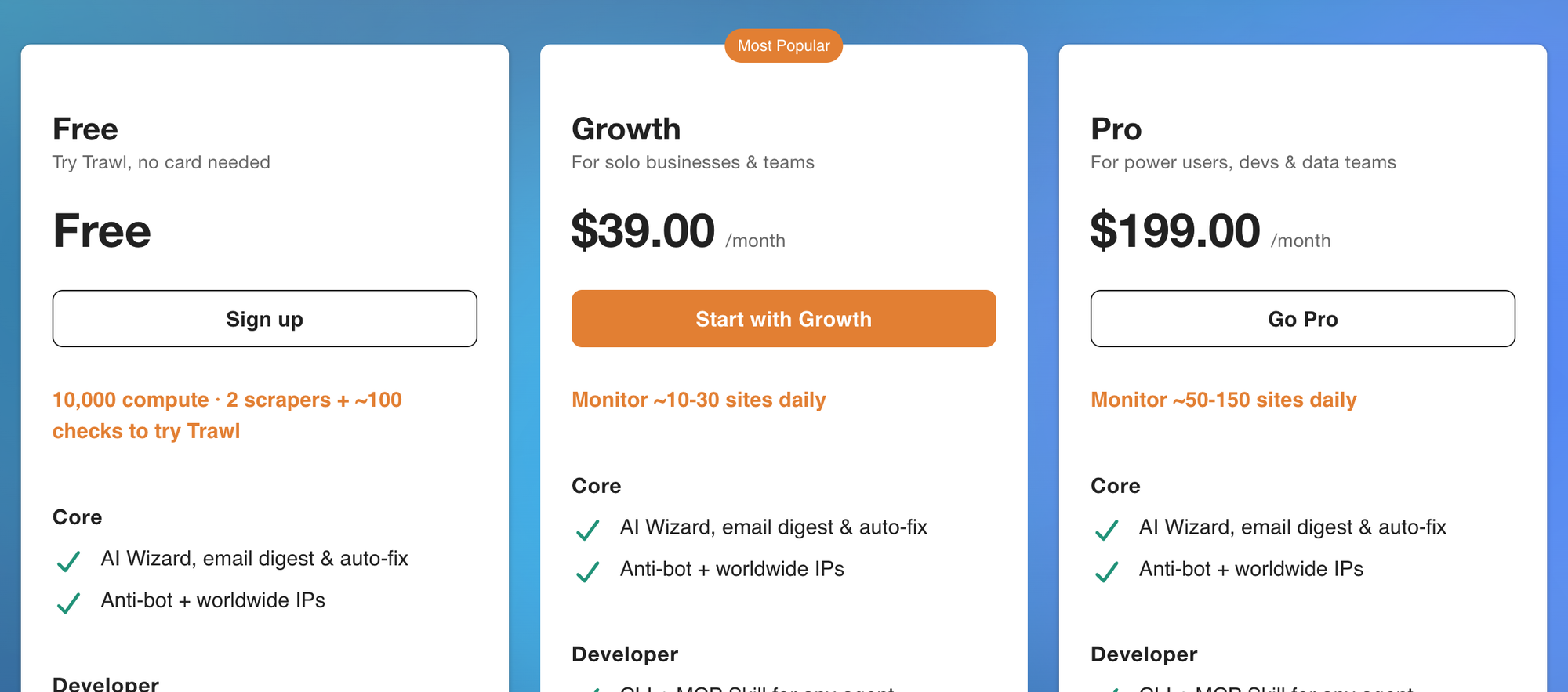
New accounts now start with 10,000 free compute, enough to build two scrapers and run about a hundred checks before you decide anything. The free compute is a one-time gift, so Trawl emails you when you have used most of it and again when it is gone, with how much is left.
For developers: where your compute goes
- 💳 Billing · Base per run: 50 compute (it was 200). That is the whole bill for a plain run on an open page.
- What adds on top: what the run really used. A proxy, a challenge to solve, an AI repair or a digest each add their own share, and your usage page shows every attempt.
- Free grant: 10,000 compute, one time, no card (it was 3,000).
- Balance emails: on a plan with no weekly quota (the free plan), one email at 80% used and one at 100%, written as compute left, never as a percentage.
- Unchanged: plan prices, weekly quotas and compute packs.
Let your AI agent install Trawl
Paste one line into Claude Code or any coding agent, and it sets Trawl up for you. It installs the command line tool and the skills, checks your key, then builds a first scraper on a page you name and shows you the data.
The line points to a page written for agents, not for people: trawl.me/install.md. Every step on it ends with a check, and every check says what to do when it fails. So your agent never guesses its way through a setup. It moves on when a step passes, and it stops and tells you exactly what went wrong when one does not.

Two things stay yours. You sign up on trawl.me and create an API key, because an agent never picks a password for you. And you choose the page to watch. Everything in between is typing your agent does.
For developers: the line, and what the page asks of your agent
Install Trawl: https://trawl.me/install.md- Six steps: install the CLI, install the skills, authenticate, health check, create the first scrap, report back.
- Exit codes it reads:
0ok,1business failure,2usage,3auth,4not found,5network. - Stateless shells: the key goes on each command, because an
exportis lost on the agent's next call. - Patience on create: a first scrap takes 30 to 250 seconds, so the page tells the agent to allow 5 minutes before it calls a timeout.
TRAWL_API_KEY=trawl_xxx trawl list --json
TRAWL_API_KEY=trawl_xxx trawl create "https://example.com" \
  --prompt "Extract the page title and the main paragraph" --json
⌨️ CLI 4: runs on Node.js 22.12 or newer, with fresh dependencies throughout.
Share Trawl with your own link
Inviting a friend to Trawl already earned you compute. Now you also have a personal link you can post anywhere, and when someone signs up through it, they get 5,000 free compute and so do you.
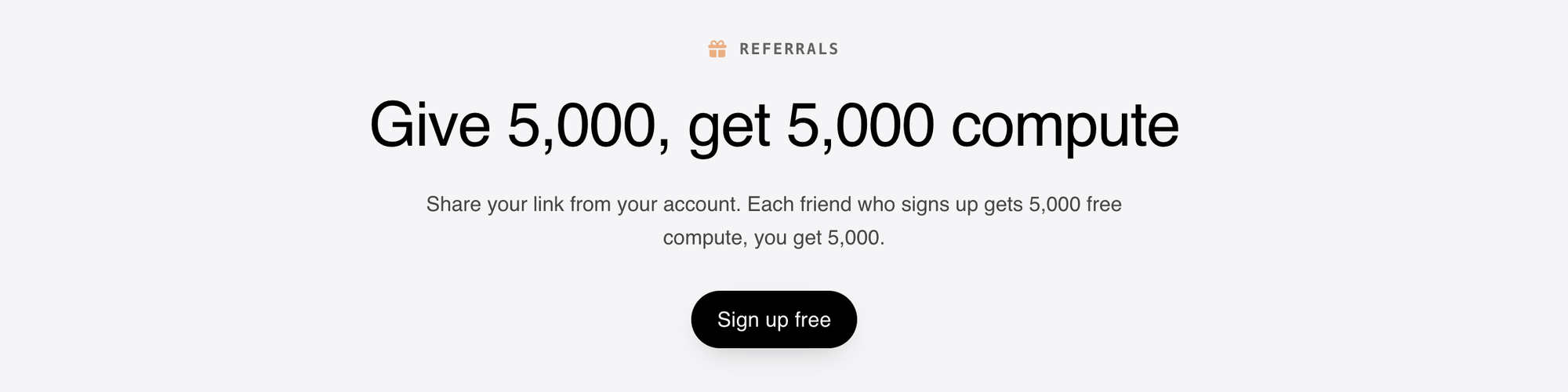
Your link is in the Referrals tab of your account, ready to copy. 5,000 compute is about a hundred plain runs, so one friend who joins keeps a small scraper going for months.
For developers: your link from the terminal
trawl referral --json{
"referralCode": "k7Qm2xPa",
"referralLink": "https://trawl.me/signup?ref=k7Qm2xPa",
"reward": "Each friend who signs up with your link gets
5,000 free compute; you get 5,000."
}The reward line is one string in the real output, wrapped here to fit. The command reads your profile, so it needs a signed-in session (trawl login), not an API key.
Scenarios, with the same care on every run
The saved settings a scraper runs with are now called scenarios, and Trawl shows a hint when no schedule is watching one. A run you launch yourself with a scenario, from the API, MCP or the CLI, now gets the same care as a scheduled run: if the site changed, Trawl repairs the scraper.
When you launch a run with your own one-off values and it comes back empty, Trawl first replays one of your saved scenarios. If that one still works, your values were the reason and the scraper stays as it is. If it fails too, the repair starts on its own.
For developers: which runs get what
- 🔗 API · 🔌 MCP · ⌨️ CLI · Scenario runs: a triggered run whose values equal a stored scenario (or a scrap with no values at all) gets the full scheduled-run treatment: the regression check, the AI repair, the climb to a stronger proxy tier.
- Verdicts: a regressed run is stored as a regression. MCP reports it as failed; the REST call still answers 200 with its
result. - One-off values: an empty or crashed run queues one replay of a stored scenario, at most once every 24 hours per scrap.
trawl trigger <scrap-id> --wait # no --param: a scenario runAlso new
- 🌐 Web app · Email preferences: switches on your account page choose which mails you get, and every product mail carries a one-click unsubscribe.
- 🌐 Web app · A welcome email: it arrives as soon as your workspace is ready.
- 🌐 Web app · A new logo: darker colours, and the same mark on every screen, from the sidebar to the sign-in page and the browser tab.
- ⚙️ Platform · Proxy error pages caught: a bare 502, 503 or 504 page sent by a proxy counts as a block, never as your data.
- ⚙️ Platform · Keep-data scrapers update field by field: a row that comes back with some of its fields updates those fields, keeps the others, and every field keeps its own history.
- ⌨️ CLI · trawl referral: prints your referral link and the reward.
Give your agent the install line tonight, name a page you check by hand every morning, and let Trawl take that check off your list. Try Trawl free.
Previous release: Trawl 3.3: AI Features Now Cost the Same as a Scrap.
Written by Pierre | October 2026